Nuestra Editorial
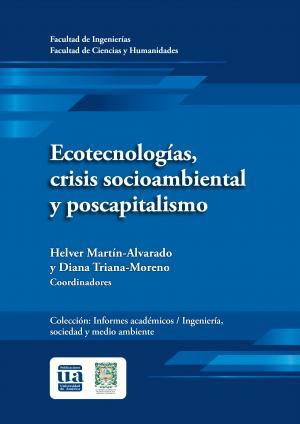
Ecotechnologies, socio-environmental crisis, and post-capitalism
Keywords:
desarrollo sostenible, poscapitalismo, educación, medioambienteSynopsis
The book addresses climate change and socio-environmental conflicts of global impact linked to sustainable development. It gathers approaches from several disciplines belonging to the social, exact, education sciences, and engineering. It aims to define the current transformations in the political, environmental, and education spheres. The scope is theoretical and practical: while the first chapters try to diagnose the present situation in the Anthropocene discussion, focusing on legal agreements or existing social problems, the following propose solutions through innovations and strategies to tackle water pollution or resort to green chemistry and biotechnology for better treatment of toxic wastes. Other contributions explore the economic effects on the world since the current pandemic has transformed capitalism. Finally, the book includes two chapters on the necessity for preparing citizens to face these situations from the internationalization of the curriculum and pedagogy or the specific citizenship competencies with a global perspective. Professionals in all areas of knowledge must undertake this preparation in the 21st century.
Chapters
-
Preliminares
-
Prolog
-
Introduction
-
Politics, Social Crises, and Nature in the Anthropocene
-
The Escazú AgreementTowards a Paradigm of New Sustainable Societies
-
Towards a Pragmatic Criminal Policy
-
On the Challenge of Humanity and the Role of Chemistry in the Face of Climate Change
-
Water is LifeAn Ecofeminist Perspective
-
Sustainable Treatments for the Valorization of Used Oils from the Industrial and Transport Sector
-
Bioeconomy and Sustainable DevelopmentProspects and Realities of their Applications and Socio-Environmental Impact
-
Importance of Feelings in the Current Economic and Environmental CrisisBeyond capitalism
-
Post-Pandemic WorkGlobalized or Nationalized Economic Activity?
-
Pedagogical Teaching Practice from the Internationalization of the Curriculum
-
Education and its Need for TransformationA Critical Approach to the Global Citizen
-
General Conclusion
Downloads
Download data is not yet available.
References
Agamben, G. (2021). ¿En qué punto estamos? La epidemia como política - 3ra edición ampliada (R. Molina-Zavalía y M. T. D’Meza Pérez, trads.). Adriana Hidalgo Editora.
Albelda, J., Parreño, J. M., Marrero Henríquez, J.M. [Coords.] ( (2018). Humanidades Ambientales. Pensamiento, arte y relatos para el siglo de la gran prueba. Catarata.
Belaïd, F. y Cretì, A. [Eds.] (2021). Energy Transition, Climate Change, and COVID-19. Economic Impacts of the Pandemic. Springer Nature Switzerland.
Diersksmeier, C. (2019). Libertad cualitativa. Autodeterminación con responsabilidad mundial (B. Moreno Carrillo, trad.). Herder Editorial
de Sousa Santos, B. (2021). El futuro comienza ahora. De la pandemia a la utopía (A. Aguiló y J. L. Exeni Rodríguez, trads.). Ediciones Akal.
Dingo, M. P., Simões, A., Duatte Rodrigues, A. y Scarso, D. [Eds.] (2019). Gardens and Human Agency in the Anthropocene. Routledge.
Emmett, R. S. y Nye, D. E. (2017). The Environmental Humanities. A Critical Introduction. The MIT Press.
Food and Agriculture Organizatio [FAO] (2020). La recesión económica mundial causada por la COVID-19: evitar el hambre debe ser un objetivo central del estímulo económico. Roma. https://doi.org/10.4060/ca8800es
Gudynas, E. (2014). Derechos de la Naturaleza y políticas ambientales. Jardín Botánico José Celestino Mutis / Centro de Investigación y Desarrollo Científico.
Giuliani, G. (2021). Monsters, Catastrophes and the Anthropocene. A Postcolonial Critique. Routledge.
Heise, U. K., Christensen, J. y Niemann, M. [Eds.] (2017). The Routledge Companion to the Environmental Humanities. Routledge.
Klonowski, D. (2021). Venture Capital Redefined. The Economic, Political, and Social Impact of COVID on the VC Ecosystem. Palgrave Macmillan.
Oppermann, S. y Iovino, S. [Eds.] (2016). Environmental Humanities. Voices from the Anthropocene. Published by Rowman & Littlefield International.
Ripple, W. J., Wolf, C., Newsome, T. M., Galetti, M., Alamgir, M., Crist, E., Mahmoud, M. I., Laurance, W. F. & 15,364 scientist signatories from 184 countries (2017). World Scientists’ Warning to Humanity: A Second Notice, BioScience, 67(12) 1026–1028 https://doi.org/10.1093/biosci/bix125
Scandurra, E., Agostini, I. y Attili, G. (2020). Biosfera, l’ambiente che abitiamo. Crisi climatica e neoliberismo. Derive Approdi.
Soulé, M. E. (2014). Collected Papers of Michael E. Soulé. Early Years in Modern Conservation Biology (with Robert L. Peters). Island Press.
Union of Concerned Scientists (1992). World Scientists' Warning to Humanity. https://www.ucsusa.org/resources/1992-world-scientists-warning-humanity
van Dyke, F. & Lamb, R. L. (2020). Conservation Biology. Foundations, Concepts, Applications. Springer Nature Switzerland.
Downloads
Published
December 20, 2021
Copyright (c) 2021 Publicaciones Universidad de América
How to Cite
Forero, E., Martín-Alvarado, H., Orjuela González, J. E., Arango Gallego, M., Sanabria Español, E., Ortega-Ramírez, A. T., Triana-Moreno, D., Páez Morales, A., Moreno Arias, C., Mendoza-Geney, L., Correa-Mahecha, F., Barrera Gutiérrez, R. A., Rodríguez Casallas, J. L., Cerquera Arbeláez, C., Galindres, D. M., & Tinoco, L. E. (Eds.). (2021). Ecotechnologies, socio-environmental crisis, and post-capitalism. Publicaciones Universidad de América. https://doi.org/10.29097/9789585303072