Nuestra Editorial
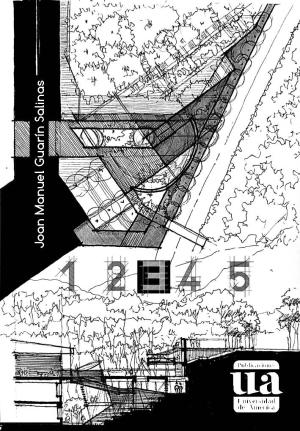
Español 1-2-3-4-5 a manual for composing: Un manual para componer
Keywords:
Arquitectura, Diseño arquitectónico, Lenguaje visual, Visión espacialSynopsis
This book of diverse drawings in design composition, based on the teaching experience of Joan M. Guarín, presents a five-step method to unlock creativity and materialize ideas. The reader will learn to compose and organize visual elements in two and three dimensions, exploring aspects such as geometric structure, formal plasticity and space. The book, with a graphic approach based on spontaneous drawings, structures the content around basic scenarios of architectural design, such as paper, the city, buildings, the lot and topography.
The main objective is to overcome the fear of the blank page, recognizing creativity as a skill that can be developed. Playful exploration, experimentation and confidence in one's own creative ability are encouraged. The proposed method emphasizes the interrelation between two-dimensionality and three-dimensionality, urging us to observe, analyze and translate ideas between the plane and space. Constant practice, cutting design and drawing are encouraged as a tool for graphic thinking and the integration between intuition and reason, and the acceptance of error as part of the creative process.
This book is not a rigid manual, but rather a motivational guide for design students and professionals seeking to enhance their spatial vision, their visual language, and their capacity for creative expression. It is presented as an invitation to action, to "scratch" and to enjoy the exciting experience of design composition.
Downloads
Download data is not yet available.
References
Arnheim, R. (1954). Arte y percepción visual: Psicología de la visión creadora. https://drive.google.com/file/d/0B37mDcEqlw9qSnB1YTA2dTg1UjQ/view?resourcekey=0-jv8DAKHhdcol0UovG6fYqQ
Ching, F. D. K. (2014). Architecture: Form, space, & order (4th ed.). John Wiley & Sons. https://dokumen.pub/qdownload/architecture-form-space-amp-order-paperbacknbsped-1118745086-9781118745083.html
Csikszentmihalyi, M. (1996). Creativity: Flow and the psychology of discovery and invention. Harper Perennial. https://inspiredbyislam.wordpress.com/wp-content/uploads/2022/08/creativity-flow-and-the-psychology-of-discovery-and-invention-mihaly-csikszentmihalyi-z-lib.org_.pdf
De Bono, E. (1986). El pensamiento lateral: Manual de creatividad. https://tecnologia3bunlp.wordpress.com/wp-content/uploads/2015/03/edward-de-bono-pensamiento-lateral.pdf
Frampton, K. (1995). Studies in tectonic culture: The poetics of construction in nineteenth and twentieth century architecture. MIT Press
Gehl, J. (2014). Ciudades para la gente. Infinito. https://archive.org/details/ciudades-para-la-gente-jan-gehl/page/n7/mode/1up
Hejduk, J. (1985). Mask of Medusa: Works 1947-1983. Rizzoli.
Holl, S., Pallasmaa, J., y Pérez-Gómez, A. (2006). Questions of perception: Phenomenology of architecture. William Stout Architectural Books.
Itten, J. (1961). Arte del color. https://monoskop.org/images/8/85/Itten_Johannes_El_Arte_Del_Color.pdf
Kandinsky, W. (1979). Point and line to plane. Dover Publications.
Krier, R. (1979). Urban space. Rizzoli. Laseau, P. (2000). Graphic thinking for architects & designers (3rd ed.). John Wiley & Sons.
Lawson, B. (2005). How designers think: The design process demystified (4th ed.). Architectural Press.
Lynch, K. (1960). The image of the city. MIT Press. https://www.miguelangelmartinez.net/IMG/pdf/1960_Kevin_Lynch_The_Image_of_The_City_book.pdf
Munari, B. (1981). ¿Cómo nacen los objetos? Gustavo Gili. https://wiki.ead.pucv.cl/images/7/70/Como_Nacen_los_Objetos_-_Bruno_Munari.pdf
Palladio, A. (1738). The four books of architecture. Isaac Ware. https://archive.org/details/gri_33125011569684/page/n17/mode/2up
Pallasmaa, J. (2005). Los ojos de la piel: La arquitectura y los sentidos. Gustavo Gili. https://tallerasl.wordpress.com/wp-content/uploads/2020/03/los-ojos-de-la-piel.pdf
Rowe, C., y Koetter, F. (1998). Ciudad collage. Gustavo Gili. https://monoskop.org/images/0/05/Rowe_Colin_Koetter_Fred_Ciudad_collage.pdf
Schön, D. A. (1992). La formación de profesionales reflexivos: Hacia un nuevo diseño de la enseñanza y el aprendizaje en las profesiones. Paidós. https://josegastiel.wordpress.com/wp-content/uploads/2019/02/schc3b6n-la-formacion-de-profesionales-reflexivos-donald-schon.pdf
Sitte, C. (1945). The art of building cities: City building according to its artistic fundamentals. Reinhold. https://ia601500.us.archive.org/3/items/in.ernet.dli.2015.212097/2015.212097.The-Art.pdf
Spirn, A. (1998). The language of landscape. Yale University Press.
Tschumi, B. (1996). Architecture and disjunction. MIT Press.
Vitruvius, P. (1914). The ten books on architecture. Harvard University Press. https://ia801702.us.archive.org/32/items/vitruviustenbook00vitruoft/vitruviustenbook00vitruoft.pdf
Waldheim, C. (2016). Landscape as urbanism. Princeton University Press.
Wong, W. (1993). Principles of form and design. John Wiley & Sons.
Zumthor, P. (2006). Atmospheres: Architectural environments: Surrounding objects. Birkhäuser. https://arhitectura2tm2016.wordpress.com/wp-content/uploads/2019/09/peter_zumthor__atmospheres.pdf