Nuestra Editorial
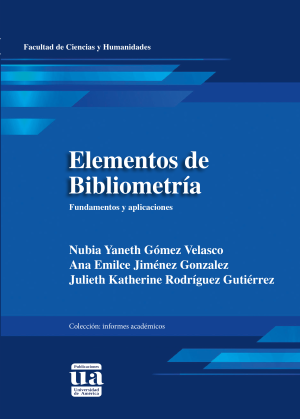
Elements of Bibliometrics. Fundamentals and applications
Keywords:
metric sciences, bibliometrics, scietific production, scientific indicators, publishing dynamicsSynopsis
The term 'bibliometrics' derives from lexical components 'biblion' meaning book, 'metron' referring to measurements and the suffix 'ia' relating quality. As a metric science, bibliometrics applies statistical and mathematical methods to describe publication processes, trends and development of scientific activity. For practical purposes, in this book it is synthetically conceived as a metric discipline that allows to analyze the dynamics of science from different laws and indicators of production, collaboration, visibility and impact around scientific publications.
Given the multidisciplinary nature of bibliometrics, its spectrum of study is very broad and diverse, due to the areas of knowledge where it can be applied, its scope beyond its quantitative measures, which allow to know the dynamics of science and its production, as well as to be part of evaluation and development methodologies and serve as a reference for planning and generation of institutional policies.
Taking into account the relevance that this scientific discipline has been acquiring in the academic and research environment, this book aims to provide fundamentals and practical applications on the use and interpretation of bibliometric techniques, illustrated from databases in the research framework of metric studies.
The book provides an initial, easy and functional orientation to understand basic concepts and classifications, as well as to glimpse the scope and transcendence that bibliometric studies can have in the scientific community, in researchers who are in training processes or those who already have a recognized trajectory in a specific line, or in the support for making micro, meso and macro decisions associated with science, technology and innovation-ST&I policies.
It should be noted that knowing bibliometric elements transcends the metric field and is equally important in research processes at all levels of education, since it allows to generate a better scope and structure of the state of the art and therefore its connection with other aspects of research, including to support a good theoretical and methodological framework.
Thus, having bibliometric fundamentals in any area of knowledge, distinguishing the software used with its different purposes and glimpsing its application in various research contexts, becomes important for many professions and opens the way to learn more about this subject by exploring the contents of this book. Among other elements that are equally inviting to read, the fact of combining conceptual foundations, techniques and applications exemplified with real data, the results obtained from the same research, the design of a simple non-sequential chapter structure, and the writing in a language that is accessible to readers, whether or not they are familiar with the field of scientific metrics, stand out.
Downloads
Download data is not yet available.
References
Ardanuy, J. (2012). Breve introducción a la bibliometría. Barcelona, España: Universitat de Barcelona.
Arencibia, Ricardo y de Moya, Félix. (2008). Visibilidad internacional de la Educación Superior cubana (2004/06): Análisis relacional de indicadores de producción, impacto y colaboración científica en revistas de corriente principal. Ministerio de Educación Superior. Editorial Universitaria.
Aria, M. y Cuccurullo, C. (2017). Bibliometrix: An R-tool for exhaust science mapping analysis, Journal of Informetrics, 11 (4), pp 959-975, Elsevier. https://www.bibliometrix.org/vignettes/Introduction_to_bibliometrix.html
Bornmann y Haunschild (2016). Citation score normalized by cited references (CSNCR): The introduction of a new citation impact indicator. Journal of Informetrics, v10, I3, pag 875-887. https://doi.org/10.1016/j.joi.2016.07.002
Burton, R. E., & Kebler, R. W. (1960). The half-life of some scientific and technical papers and technical literature. American Documentation, 11(1).
Castillo, L. (2002). Tema 11: Introducción a la bibliometría. Recuperado de http://www.uv.es/macas/11.pdf
CGCI “Centro de Gestión del Conocimiento y la Innovación”. (2011). Análisis de la Producción Científica de los Grupos de Investigación de la Universidad del Rosario: 2003 – 2009. Universidad del Rosario. Bogotá. Informe periódico: 5. http://www.urosario.edu.co/investigacion/documentos/dinfopublcientif-11/
Chinchilla-Rodríguez, Z. (2004). Análisis del dominio científico español: 1995-2002 (ISI, Web of Science).
Egghe Leo y Ravichandra Rao, (1992). Classification of growth models based on growth rates and its applications. Scientometrics, 25 (1) (1992), pp. 5-46
Faber, F. T., Eriksen, M. B., & Hammer, D. M. G. (2021). Obsolescence of the literature: A study of included studies in Cochrane reviews. Journal of Information Science, 01655515211006588.
Freeman, L. (1977). A set of measures of centrality based on betweenness. American Sociological Association, 40 (1),35-41.
Glänzel, W (2001). National characteristics in international scientific co-authorship relations. Scientometrics, 51(1): 69-115
Gorbea, S. (2005). El Modelo Matemático de Lotka sobre la distribución de frecuencia de la productividad científica.UNAM.p.1-59.
Hall, D. H. (1989), “Rate of growth of literature in geoscience from computerized databases”, en Scientometrics, 17 (1/2): 15-38.
Huamaní, Charles y Mayta-Tristán, Percy. (2010). Producción científica peruana en medicina y redes de colaboración, análisis del Science Citation Index - 2000-2009. Rev. Perú Med. Exp. Salud Pública 27(3): 315-25.
Ibáñez, Alfonso; Bielza, Concha y Larrañaga, Pedro. (2011). Productividad y Visibilidad Científica de los Profesores Funcionarios de las Universidades Públicas Españolas en el Área de Tecnologías Informáticas. Universidad Politécnica de Madrid. Ministerio español de Ciencia e Innovación, Proyecto TIN2008-04528-E. Rescatado de: http://oa.upm.es/9407/1/analisis-bibliometrico.pdf
Katz J. S, y Martin, B. R. (1997). What is research collaboration? Research Policy, 26, 1–18.
Licea de Arenas, J. (1993). "Indicadores de la actividad científica." Ciencias de la Información 24(1): 2-6.
López-Piñero J.M. y Terrada M.L. (1992). “Los indicadores de producción, circulación y dispersión, consumo de la información y repercusión”, Medicina Clínica, núm. 98: 142-148.
McGrath, W. (1989). What bibliometricians, scientometricians and informetricians study; a typology for definition and classification; topics for discussion. Paper presented at the International Conference on Bibliometrics, Scientometrics and Informetrics, Ontario: Second Conference... The University of Western Ontario
Ospina Rúa, Diana. (2009). Caracterización de la producción científica y visibilidad de los investigadores de la Universidad Nacional de Colombia sede Medellín en la ISI Web of Science (1990-2007). Tesis de Maestría en Ingeniería Administrativa.
Paz, L., Peralta, M., y Hernández, E. (2016). Estudio bibliométrico de la Revista Centro Agrícola, Cuba. e-Ciencias de la Información, 6(2), 1-21. doi:10.15517/eci.v6i2.25273
Price (1956), DS. “The exponential curve of science”, en Discovery, 17: 240-243. [Reimpreso en Bernard Barber & Walter Hirsch (ed.), The sociology of science. New York: The Free Press of Glencoe, 1962, 516-524.].
Price (1963). “Little Science, Big Science”. Columbia University Press, New York
Price (1975), “Diseases of science”, en Science Since Babylon, ed. ampliada, New Haven y London: Yale University Press, 161-195.
Restrepo Arango, Cristina (2011). “Producción bibliográfica de los historiadores de El Colegio de México”, en Investigación Bibliotecológica, mayo-agosto, 25 (54): 111-140.
Rodríguez Gutiérrez, J. K., y Gómez Velasco, N. Y. (2017) Redes de coautoría como herramienta de evaluación de la producción científica de los grupos de investigación, en Revista General de Información y Documentación 27 (2), 279-297. https://doi.org/10.5209/RGID.58204.
Rodríguez, J.K., Gómez, N.Y., y Herrera-Martínez, Y. (2017). Técnicas bibliométricas en dinámicas de producción científica en grupos de investigación. Caso de estudio: Biología- UPTC. Revista Lasallista de Investigación. Vol. 14 Núm. 2 Jul-Dic.
Ruiz de Osma, E. (2006). Aplicación del modelo Bradford en la producción científica del área biomédica de la Universidad de Granada (1988-1996). Enc. Bibli: R. Eletr. Bibliotecon. Ci. Inf., Florianópolis, n.° esp., 2.º sem.
Sánchez, M. (2002). Análisis de redes sociales e historia, una metodología para el estudio de redes clientelares (Tesis doctoral). Universidad Complutense de Madrid, Madrid, España.
Sanz Casado,E. (2000). Proyecto docente para la provisión de una plaza de Catedrático de Universidad sobre Bibliometría. Getafe: Universidad Carlos III de Madrid.
Sanz Casado, E. (1994). Manual de estudios de usuarios. Madrid: Fundación German Sánchez Ruipérez.
Sanz Casado, E., Suarez Balseiro, C., & García Zorita, C. (1998). Estudios de la producción científica española en biomedicina 1991-1996. Paper presented at the Jornadas sobre Documentación y Ciencias Médicas, Universidad de Zaragoza.
Sedeño, E. (2013). Indicadores bibliométricos para determinar el envejecimiento de las referencias bibliográficas. Revista Caribeña de Ciencias Sociales. Recuperado de http://caribeña.eumed.net/indicadores-bibliometricos-envejecimiento-referencias-bibliograficas/
Sjøberg, D.I. (2010). Confronting the myth of rapid obsolescence in computing research. Commun. ACM, 53, 62-67. Doi:10.1145/1810891.1810911. Disponible en: http://folk.uio.no/dagsj/sjoberg-CACM-Sep-2010.pdf
Spinak, E. (1998). Indicadores cienciométricos. Ciência da Informação, 27, 141-148.
Suárez E. A (2014). Uso de indicadores cienciométricos en el estudio de la producción científica colombiana en el área de matemáticas (tesis de pregrado). Escuela de matemáticas y estadística, Universidad Pedagógica y tecnológica de Colombia, Tunja, Colombia.
Tomas Castera, Vicente. (2013). Estudio bibliométrico de la producción científica y de consumo de las revistas sobre nutrición indizadas en la Red SciELO. Universitat d’ Alacant. Tesis Doctoral.
Tomás-Górriz V, y Tomás-Casterá V (2018). La Bibliometría en la evaluación de la actividad científica. Hosp Domic; 2(4):145-63. Disponible en: https://pdfs.semanticscholar.org/4496/0425ee91c37e5261523fb36b86e715789733.pdf
Urbizagástegui, R. (2004). La productividad científica de los autores un modelo de aplicación de la Ley de Lotka por el método del poder inverso generalizado. INFORMACIÓN, CULTURA Y SOCIEDAD. n.12.p.51-73
Urbizagástegui R. (2009), “Crescimento da literatura e dos autores sobre a Lei de Lotka”, en Ciência da Informação, septiembre-diciembre, 38 (3): 111-129.
Urbizagástegui, R. (2013). Estudio sincrónico de obsolescencia de la literatura: el caso de la Ley de Lotka. Investigación Bibliotecológica, 28(63), 85-113. Recuperado de http://revistas.unam.mx/index.php/ibi/article/download/45656/41019
Urbizagástegui R. (2016). El crecimiento de la literatura sobre la ley de Bradford. Investigación bibliotecológica, 30(68), 51-72. https://doi.org/10.1016/j.ibbai.2016.02.003
Published
April 11, 2023 — Updated on April 13, 2023
Categories
Copyright (c) 2023 Publicaciones Universidad de América
How to Cite
Gómez Velasco, N. Y., Jiménez González, A. E., & Rodríguez Gutiérrez, J. K. (Eds.). (2023). Elements of Bibliometrics. Fundamentals and applications. Publicaciones Universidad de América. https://doi.org/10.29097/9786289517651